Wednesday, February 24, 2010

Dennis Lehane's “Shutter Island” Shows Scorsese to be Master of Dark Art


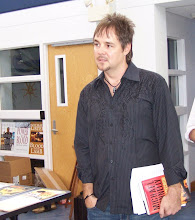
Back in November at the Miami Book Fair, while telling Dennis Lehane how much his books have meant to me, I asked him if he had seen Martin Scorsese’s adaptation of his novel, “Shutter Island.” He told me he had and that it was a masterpiece.

I couldn’t agree more.

At 67, Martin Scorsese is at the height of his powers as a filmmaker.

And for the third time—three for three—Mr. Lehane has had one of his novels adapted successfully (the others being “Mystic River” and “Gone Baby Gone”).

It’s rare for an author to have one good film made of his or her work, but three? It’s unheard of. I asked him why he thought he’d been so fortunate, and he said it was because in each case, a true auteur was involved—an artist with a vision to serve as author of the film. In the same way Mr. Lehane is the author of his books, Clint Eastwood was the author of “Mystic River,” Ben Affleck, of “Gone Baby Gone,” and, now, Martin Scorsese of “Shutter Island.” Just as a great novel must have a visionary artist, a great film needs a single-minded director, an alchemist who takes all the disparate elements and makes magic.

It’s 1954, and up-and-coming U.S. marshal Teddy Daniels is assigned to investigate the disappearance of a patient from Boston’s Shutter Island Mental Hospital. He’s been pushing for an assignment on the island for personal reasons, but before long he wonders whether he hasn’t been brought here as part of a twisted plot by hospital doctors whose radical treatments range from unethical to illegal to downright sinister. Teddy’s shrewd investigating skills soon provide a promising lead, but the hospital refuses him access to records he suspects would break the case wide open. As a hurricane cuts off communication with the mainland, while more dangerous criminals escape in the confusion, and the puzzling, improbable clues multiply, Teddy begins to doubt everything - his memory, his partner, even his own sanity.

I have been an admirer of Dennis Lehane since, while doing a book signing for my first novel at Murder on the Beach in South Florida back in1997, Joanne Sinchuck, the store’s owner, recommended I read “Sacred,” which had just come out. It was so good, I had soon read everything he’d written, and have continued to read each new work as it has been published (though I’ve yet to be able to get to his latest “Remains of the Day,” because of deadlines). Of Mr. Lehane’s books I’ve read “Shutter Island” is my favorite just behind “Gone Baby Gone,” but I highly recommend all of his work as some of the very best contemporary crime fiction being written.

With “Shutter Island” the film, what Scorsese has done is take a great novel and do it justice by making it into a powerful cinematic experience. He uses the language of cinema to offer a film that, to me, is more translation than adaptation. It’s faithful to the book in many literal and all spiritual ways.

Sitting in the dark theater watching Scorsese’s “Shutter Island,” I kept thinking this is a masterwork by a true master filmmaker, that the movie is a class—Cinema 101. Every frame is full and rich and flawless, every shot stylish, every angle adding to the story being told. This is classic filmmaking by an elder statesman cinephile who here realizes the promise of his potential—and obviously has fun doing it.

“Shutter Island” doesn’t just show a director doing his best work, but a film student—perhaps the most serious film student of any working director—who has become a scholar, and his teachers, his influences, are everywhere present. No doubt we are seeing the tutelage and inspiration of Truffaut, Wilder, Kurosawa, Fellini, and many, many others. But the two filmmakers I continually saw in frame after frame, shot after shot, in the mise en scène, in the camera placement and movement, were Hitchcock and Kubrick. Perhaps it can be argued that this is a result of the film’s gothic material and crime genre, but I think that’s only part of why these great directors came to mind. For decades, Scorsese has been film’s most eloquent spokesperson. In “Shutter Island” the film itself becomes the spokesperson, eloquently, exquisitely speaking the language of cinema.

Some have called the film too gloomy, too atmospheric, too dark. For me, the film, like the book, captures perfectly, if painfully, the psychological, spiritual, and physical condition of its time, place, and people. There’s a world of difference between mood and emotion. Too many filmmakers go for emotion—manipulating audiences into a momentary emotional reaction, but here, the master, creates a mood, a relentless, pervasive experience that creeps in like a fog off Boston Harbor into a man’s marrow. And stays there. It’s the difference between an immediate effect and a being truly affected by a work of art.

A few critics have dismissed both the book and the film as hokum, as some sort of parlor game unworthy of writer and director, but, to me, this reveals a genre prejudice, an unwillingness to even consider that a work with some certain genre conventions can also be art. Some have actually indicated that Scorsese has invested too much craft, too much attention to detail, too much cinematic art in “Shutter Island.” They seem to be saying that if a work can be classified in a particular genre, if it has twists and turns, an actual plot, and a devastating dénouement, it should be made with less care, less skill, less everything in order to justify their unsupported belief that it is indeed somehow less.

“Shutter Island”—both the book and the film—is a haunting, affecting story with both substance and thrills. It’s entertaining and enlightening, a genre work and a work of art, and the two men responsible—Lehane and Scorsese—are very, very good at what they do, masters of their mediums, artists and craftsmen, entertainers extraordinaire to be sure, but also provokers of thought, nourishers of soul. Read the book. See the film. Preferably in that order.

Thursday, February 18, 2010

Audience Participation


This past weekend, I had an experience in a movie theater that connected to a similar experience I had some twenty-three years ago.

I was in a huge, packed theater in Tallahassee with my daughter because I’m a good dad and she wanted me to see “Valentine’s Day” with her. The movie itself is okay—a little obvious with weak writing, but a stellar cast and some real charm. Meleah, my 19 year-old daughter loves it and has seen it three times so far. This makes me love the movie, too. It just doesn’t make the movie any better.

A little background:

Back in 1986, I left the small town of Wewahitchka, Florida, and moved to the big city of Atlanta, Georgia, and going from a place with one traffic light to a place with six-lane interstates was just one of the differences I encountered. Some things were definitely different, true, but not everything. I thought I had left the bigotry and small-mindedness of small Southern towns behind, but I was wrong.

After living in Atlanta for several months, I went with a friend to a theater in the Atlanta suburb of Conyers (this was circa 1987). The movie was, “Fatal Beauty,” and at the end of it, after surviving several acts of violence and a couple of shootouts, Sam Elliott and Whoopi Goldberg kissed. The audience reaction that followed was a horrible, ugly display of racism. After boos and groans and angry expressions, someone shouted, “Just shoot them both right now.”

Twenty-three years later, in a filled-to- capacity theater in Tallahassee, in “Valentine’s Day,” Jamie Fox and Jessica Biel kissed and no one said a word or made a sound—except happy ones.

This made me happy. It’s real progress. (Even if it can be argued that most audiences would find Mr. Foxx and Ms. Biel far more palatable than Mr. Elliott and Ms. Goldberg no matter what they were doing). And it came about because of people like Sam and Whoopi—and so many writers and directors, novelists and painters, and artists (not to mention activists and martyrs; I’m dealing with arts and entertainment and its cultural impact here) who express both how the world is and how it can be.

Don’t get me wrong. I have long since been disabused of my belief in the moral progress of man. Even as a segment of the world’s population is growing and evolving in love and oneness, in wisdom and understanding, another is growing even more militant in its ignorance and fear and hatred.

Still, these two experiences in movie theaters in the South are linked in my mind, and I do see my most recent theater experience as progress of a kind. But the two experiences are linked in another way as well—in a far more discouraging way. Sadly,
both are also linked by expressions of bigotry.

True, no one moaned or groaned when Jamie Fox and Jessica Biel kissed, but they certainly did when the two gay characters did.

When Eric Dane and Bradley Cooper kissed, the bigoted, homophobic reaction was just as bad as the bigoted racist reaction had been at “Fatal Beauty” two decades earlier, and I sat there thinking how sad humans are in the nearly universal tribalism that wants an “us” and a “them.” Why do we need a group to despise, to identify ourselves by, a group for which we say our god loves us but hates them?

The negative reaction was even more poignant because, based on the comments from the women in the audience, the two men were the most attractive on the screen, and long before it was revealed that they were gay, many of the women around me were whispering their approval of and desire for them.

The hopeless optimist in me believes (or badly wants to) that we are evolving, becoming (culturally) our better selves, but another voice inside me says that human history shows not progress so much as a shuffling of bigotry from one group to another. Please, please, please, please, please, please help me prove that voice wrong.

Wednesday, February 10, 2010

The Long Hall


Interesting things happen in halls. In them, we encounter neighbors or classmates or family. We bump into and are introduced to strangers. We carry things and move things. We say hello and kiss goodnight. But mostly hallways are places of transition—the not-quite-there-yet limbo between where we have been and where we are going.

Two recent films, “Across the Hall” and “Adam,” which couldn’t be more different, both have hallways playing significant roles in them. In “Adam,” the main character falls in love with a girl he meets in an apartment building hallway, and in “Across the Hall,” dark deeds happen in and on either side of a hotel hallway.

“Across the Hall”

An expanded version of his 2005 short film of the same name, director Alex Merkin's “Across the Hall” is a feature-length noir thriller that follows the tense standoff between a young man, his best friend, and his fiancée. Mike Vogel appears opposite Brittany Murphy and Danny Pino in a film penned by Merkin and Jesse Mittelstadt—the same two who collaborated on the original short film.

A quiet night takes a dangerous turn when Julian receives a frantic phone call from his best friend, Terry, who has followed his unfaithful fiancée, June, to a downtrodden Riverview hotel on the other side of town. Having a bottle of whiskey in one hand and a revolver in the other, Terry is staked out in the room across the hall from her.

As noir as anything I’ve seen recently, “Across the Hall,” has more style than substance, but enough more that you might not notice. That said, it is a well constructed thriller with some nice twists and surprises that manages to build and sustain tension.

Desire is a powerful force—one that not only propels us through life, but actually is life, causes life to be, causes life to continue. But there’s a dark side of desire. The desire for another, so primal, so pure, can turn into jealous possession—a violent grip that can squeeze the life out of a relationship. Love is freedom. The two words come from the same root, and you can’t have one without the other for very long—freedom is oxygen that feeds love’s flame. If love is present, our most passionate possessings of others will be simultaneously releasings. This is clearly something Terry doesn’t understand. Gun in hand, he’s going to force June to get into the cage of his desire and eliminate the competition for her affection. The Buddha says end desire and you end suffering, and though non-attachment is certainly a solution, for me, fully attaching in love and freedom is the better way—though, actually, the two approaches are far more closely aligned than they may appear to be. We were created to be free. God, the universe, the world, only give us freedom. If we are imprisoned it is our own doing—including submitting to the dark side of someone else’s desire and the cell their control wants to lock us in.

Merkin’s movie has some very nice touches, and though he calls “Across the Hall” a “psychological thriller, a Hitchockian story,” that’s a bit of a stretch. Hitchcock is far more subtle, far more restrained, far more refined. Still, Merkin manages to sustain a delicious sense of dread, and his old, empty, dark hotel on a rainy night provides enough atmosphere for a couple of films.

One of Brittany Murphy’s last films, “Across the Hall” shows her sultry little lost wild child/almost-a-woman sexuality, that, like her voice is sexy, but a bit awkward. Of course, this vulnerability adds to her appeal.

“Adam”

In a very different hall, two misfits meet and miscommunicate.

In this sweet, charming romantic dramedy, Hugh Dancy (“The Jane Austen Book Club”) plays Adam, an intriguing and handsome young man with Asperger Syndrome, who has led a sheltered existence his entire life—and probably would’ve continued to, but when he meets his new neighbor, Beth (“Knowing”), a beautiful, understated young woman, she pulls him out into the world in ways he could’ve never imagined. The results are funny, touching and entirely unexpected. Their implausible and enigmatic relationship reveals just how far two people from different realities can stretch in search of an extraordinary connection.

“Adam,” both the lead character and the film itself, is sweet—with quiet but palpable charm and very real appeal.

Genuine connections are rare, deep connections difficult—realities only complicated by Asperger syndrome, an autism spectrum disorder that involves significant challenges in social interaction, along with restricted and repetitive patterns of behavior and interests. Adam’s condition presents him with obstacles to intimacy that at times seem insurmountable. But when it comes to relationships, I think we’re all more like Adam than we’d care to admit.

Having authentic, abiding, actual connections with others and being involved in every crevice of at least one other person (and maybe more) is what we most long for, but our relational Aspergers keeps us trapped inside ourselves, unable to risk the naked, egoless, love-based vulnerability required for true and utter human bonding. And sometimes, tragically, even when we have our own relational Aspergers under control, the person we’re attempting to relate to is unable to because of theirs.

Like Adam, part of what keeps us imprisoned in our relational Aspergers is rigidity. Our pride and egos and lack of love leave us wounded, defensive, unable to bend, unable to forgive. When Adam refuses to forgive Beth for her humanness, his wise older friend says, “Everyone is a liar. You’ve just got to figure which liars are worth loving.” It’s obvious from the very beginning that getting involved with Adam is risky for Beth, but Adam is also taking a risk, as we all do in connecting with others. Perhaps nothing is as risky, but certainly nothing is more worth the risk.

Interesting things happen in halls—sometimes life-altering things. After all, it’s not the destination, but the journey that most determines who we are and the quality of our lives. And you could do worse than spending some time in the dark hallways of the Riverview Hotel or the dingy hallways of Adam and Beth’s apartment complex. Both are aspects of the long hall of humanity. In fact, life itself is a hallway lined with doors—each representing options, opportunity, and, ultimately in the choosing, destiny.

Wednesday, February 3, 2010

A Doubly Single Man


Fashion designer Tom Ford’s directorial debut of Christopher Isherwood’s novel, “A Single Man” is a faithful, yet artistic, adaptation, and ultimately an extraordinary film. Financed by Ford himself, this stylistic work of art affords Colin Firth the role of a lifetime.

Set in Los Angeles on November 30, 1962, “A Single Man” is the story of George Falconer (Colin Firth), a middle-aged British college professor who has struggled to find meaning in his life since the sudden death eight months earlier of his longtime partner, Jim (Matthew Goode). Throughout the single day depicted in the film, and narrated from his point of view, George dwells on his past and his seemingly empty future as he prepares for his planned suicide that evening. Before meeting his close friend Charley (Julianne Moore) for dinner, he has unexpected encounters with a Spanish prostitute (Jon Kortajarena) and a young student, Kenny Potter (Nicholas Hoult), who has become fixated on George as a kindred spirit.

You’d expect a designer like Ford to make pretty pictures of pretty people wearing pretty closes standing in pretty places, but unlike so many music video directors who are unable to combine beautifully shot images and symbols into narrative, Ford integrates style and substance in brilliant, effective, and evocative ways.

“A Single Man” is about, among other things, being single, and as I watched the frames unspool and bathe the enormous screen, I began to think about what this means. In one sense, we’re all single. In another, none of us are. When most people think of being single, they think of someone who has no sexual partner, no primary person, no automatic plus-one for every situation that calls for it. Of course, many, if not most, still equate this with marriage. One is single until one is married. But there are plenty of single married people; plenty of people who are not married and couldn’t be less single.

Interestingly, George doesn’t just appear to be single now that Jim is dead, but because their relationship is rejected by society, he appeared to be so even when Jim was alive and they were together. This is true of all secret or non-sanctioned relationships—which, at various times and in various places, have included race, religion, sex, age, family, nationality, number of partners, sexual orientation, etc.

George is an acutely single man in the sense that he isn’t allowed to truly grieve for his great love because family and friends and coworkers and the community don’t recognize the relationship, don’t value Jim and George and what they have. This imposes an intolerable level of suffering atop an already unimaginable experience of loss—a depth of isolation to join the desolation—that makes him a doubly single man. Just imagine how this compounds and complicates, extends and exponentially multiplies the difficulty of something that is impossibly painful to begin with.

The book and the film include a fascinating discussion about minorities and the fear they elicit from the majority. This fear is based on a perceived threat, and whether it’s because of race or religion or sex or sexual orientation, it is the result of small heartedness within the haters that cause them to operate in fear not love, inside a paradigm of scarcity where the freedom, happiness, lifestyle, and even existence of “the other” is seen as somehow robbing them of these very things.

Most of us, comfortably ensconced in the majority, can’t imagine what it’s like to be a minority, but we should continually try. And like, Gregory Peck in “Gentleman’s Agreement,” we should look for opportunities to be a minority—or at least be thought of as a minority. When we are empathic, we are our very best selves. When we are compassionate, we are most like God.

Because I have so many good, dear friends who happen to be gay, and because I love and spend time with them—including in gay friendly places and events, I’ve had people ask if I’m gay. This is a great honor to me. And to all the homophobes out there (because it only matters to you), please consider me gay—in fact, consider me the gayest of gays.

In the midst of writing this, I took a lunch break at a restaurant showing the Don’t ask, Don’t tell hearings, and it struck me just how short a distance we’ve come in the forty-eight years since the events of “A Single Man.” How can we continue to justify our bigotry, our fear, our so very small minds, our utter lack of love? How can we continue to fashion all too human gods who lend a sense of righteousness to our prejudices?

The film takes place in the shadow of the Cuban Missile Crisis, and an already-dead-and-doesn’t-know-it coworker tells George he should build a bomb shelter but not tell anyone because, when it’s needed, the world at that time won’t be a place for sentiment. George, who knows more about death and loss and loneliness than his coworker could ever imagine responds that he wouldn’t want to live in such a world.

As a single man, George, like the rest of us, longs to make a meaningful connection with others—something he did with Jim, something his enormous grief makes impossible now. When one of his students observes how we’re all trapped in the prisons of our own bodies and how we can never know what others are really like inside, never experience the world as they do, George recalls how the times he’s spent connecting with other human beings have made his life worth living. Now, unable to connect, he no longer wants to live.

Throughout “A Single Man,” George talks about certain moments of clarity he experiences, and how they change him and transform his perspective, his very worldview in ways he can scarcely describe. These revelations, these sublime epiphanies, are little reverberations of mystical insight, grace-filled glimpses that point to so much more—the more of life, the more that it and we can be. Watching “A Single Man,” was just such an experience for me—a moving, memorable one of clarity, insight, even epiphany.

Wednesday, January 27, 2010

When the Student is Ready . . .


What is an education? How does one go about getting one? Where can both knowledge and wisdom be obtained? These are not only questions I’ve spent my life trying to answer, but those explored by the intelligent and insightful, smart and sexy new film, “An Education.”

In England in 1961, following a youth orchestra rehearsal, bright, beautiful schoolgirl Jenny is given a lift home by a charming older man, David. The two strike up a relationship which includes David’s business partner Danny, and Danny’s vapid mistress, Helen. David charms and coaxes Jenny’s protective parents into allowing him to take her to concerts, jazz clubs, and even to Paris.

David goes out of his way to show Jenny and her family that his interest in her is not improper and that he wants solely to expose her to cultural activities which she enjoys. Jenny quickly gets accustomed to the life David and his companions have shown her, and Jenny and David's relationship takes a romantic turn. After seeing Jenny dance with Danny, David hastily proposes marriage. Her father agrees to the engagement, and Jenny has to decide what kind of education she’s going to pursue—David’s lifestyle or higher education at Oxford.

Jenny’s entire life is spent in pursuit of an education, but when she meets David, she realizes for the first time just how limited her, her parents, and her school’s view of an education really is. What Jenny is experiencing and what she must confront reminds me of what John Adams said—“There are two educations. One should teach us how to make a living and the other how to live.”

Life itself is an education—if we’ll let it be. It’s all in the approach—open, humble, hungry or closed, stubborn, incurious.

Nothing troubles me more—not even greed or violence—than the vast segment of the world’s population that is anti-intellectual and proudly, even militantly ignorant. Allan Bloom said that “education is the movement from darkness to light.” Herein lies the great tragedy—light has come into the world, but people love darkness. We shouldn’t be afraid of the unknown, but the self-destructive defensiveness of not wanting to know. Wanting to know—asking, seeking, thinking—is the very beginning of education.

Education is any act or experience that has a formative effect on the mind, character, or physical ability of an individual, the process by which accumulated knowledge, skills, and values are deliberately transmitted and received.

Think about all those elements—any act or experience that has a formative effect on us, and the process by which accumulated knowledge is deliberately transmitted and received.

There are many, many ways to get an education. The vital thing is that we get one, not how we get it. And, of course, the best educations are those received through a variety of means, by a plethora of professors.

Are we being educated? If we’re not, we only have ourselves to blame. We are responsible for our own education. And we have access to everything we ever need to receive the best education in the history of humanity—bookstores, libraries, museums, the internet, and life itself. When I think of all we have within our grasp and all the ways we fail to take advantage of it, I think of what Mark Twain said about reading—“the man who doesn’t read good books has not advantage over the man who can’t read them.”

“An Education” is not merely entertaining, but inspirational. It’s a wise and witty film, well made, well acted, well written. Nick Hornby wrote the screenplay based on the autobiographical essay by the British journalist Lynn Barber published in the literary magazine Granta. Barber's full memoir, “An Education,” was not published in book form until June 2009, when filming had already been completed.

This movie is magic—conveying so precisely, so powerfully the longing for knowledge and experience by an open person ready for them and the difficult choices involved in truly being educated.

Though “An Education” is filled with subtly brilliant performances—particularly by Rosamund Pike, Olivia Williams, and Peter Sarsgaard—Carey Mulligan’s performance is absolutely sublime. Her Jenny is nearly equal parts old soul and silly school girl, worldly wise woman and naïve innocent child. For nearly my entire life, I’ve been mostly attracted to older women, but Mulligan’s Jenny makes a compelling case against this practice.

Whether in her small bedroom alone with a book or on the streets of Paris, Jenny is hungry to learn, to breathe in every word, every sight, every sound, every experience. We have this in common. She thirsts, and the sheer power of it, its quintessential insatiability is overwhelming. I love this about Jenny, and it’s this aspect of her that I most identify with. These words are contained in all our other words, they are among the final words cried out by Jesus from the cross, they are the unspoken yearnings of mythic immortals who feed on the blood of others. They are the expression from the depths of ever dry and dusty soul, barely hanging on in a parched wilderness wasteland—“I thirst.”

Like Jenny, I’ve spent my life trying to “get my learn on.” I started to say my adult life, but my hunger for knowledge and true wisdom extends way back into childhood. It did, however, take a quantum leap when I finished my graduate degree and became a writer—which, after all, is how it’s supposed to be. School in general and college in particular are meant to teach us how to think, how to educate ourselves. Henry Adams said, “They know enough who know how to learn.”

In the midst of writing this, I happened to glance down at a bookshelf not far from my writing chair at two books I bought just for information—“An Incomplete Education” and “The Knowledge Book.” The books are two among thousands and thousands in my study/cave/sanctuary, for I truly believe what Thomas Carlyle said: “What we become depends on what we read after all of the professors have finished with us. The greatest university of all is a collection of books.”

Buddhism teaches “when the student is ready, the teacher will come.” When Jenny was ready, David appeared. When we are ready, we will learn—which is why it’s so important to continually remain in the humble posture of not-knowing, hungry, open seeking. It’s our best chance at a good education.

Stay open. Stay hungry. Stay ready. When we are, education will happen. We should be intentional about all things—but nothing more so than our education and enlightenment. Take. Eat. Original blessing comes from eating from the tree of knowledge and the tree of life. In fact, the tree of knowledge is the tree of life.

In the end, Jenny gets the best education—one that involves both heart and head, school and life, reading and experiencing. It’s the kind of education I’m in daily pursuit of, and the one I most wish for you, the one that, if we all received it, would most change the world.

Wednesday, January 20, 2010

RIP, RBP


I owe Robert B. Parker more than I can tell. Fortunately, several years ago at a writing conference where we were both speaking, I got the opportunity to attempt to tell him.

I am saddened by his death. His absence leaves a great big gaping hole in American Crime Fiction. One that I and others will attempt to fill, but it is truly tragic that there will never be another Spenser novel.

At the age of 77, “just sitting at his desk” at his home in Cambridge, Mass., according to an email sent out by a representative of his U.K. publisher Quercus, Robert B. Parker is dead. The news of Parker's death on Monday was confirmed by Parker’s U.S publisher, Putnam; on Twitter, a representative wrote: “R.I.P beloved author Robert B. Parker. You were indeed a Grand Master, your legacy lives on, and you will be missed by us all.”

In a statement released late Monday, Parker’s longtime editor at Putnam, Christine Pepe, said: “What mattered most to Bob were his family and his writing, and those were the only things that he needed to be happy. He will be deeply missed by all us at Putnam, and by his fans everywhere.”

I can think of no better way for a writer to go than at his desk in the act of writing. I hope to go the same way (and, if it’s at 77, I won’t complain). Wonder what the last sentence, the last word he wrote was.

For me, losing Parker is like losing one of my literary fathers.

He is one of the main reasons I became a writer of crime fiction. In high school, I watched “Spenser for Hire,” the TV series based on his one-name Boston PI, Spenser. The series led me to the books, the books led me to a love of fiction in general and of crime fiction in particular. (The TV series is also where I fell in love with Mustangs and why I still drive one today).

When I started reading Parker’s Spenser novels in 1988, the series was already about ten strong, and since then, he has added at least one every year. In fact, he wrote them faster than his publisher, Putnam, was willing to publish them.
In recent years, he’d been writing other works in addition to the Spenser novels. Among them, a couple of very good westerns, a great book with World War II, baseball, and Jackie Robinson as a backdrop, a series featuring a female PI, and a series featuring former LA cop and now Paradise, Massachusetts Police Chief, Jesse Stone.

Younger, and not as evolved as Spenser, Jesse Stone, who battles alcohol and marriage problems in addition to the bad guys, is nonetheless tough, autonomous, and honorable—hallmark traits of Parker’s knights-errant. He’s also, like nearly all of Parker’s characters, a man in the process of self-discovery.

In all Parker’s works, crime and investigation merely provide a framework for his characters, giving them something to do while the real investigation into their psyche takes place. Like the Spenser novels, the Stone books are about a man and his journey to becoming a better man, while helping weaker people along the way. This is even truer of Stone than Spenser, since Jesse is younger, more troubled, more vulnerable.

Not a lot changed from one Parker book to another. I don’t mean to suggest that Parker wrote the same book over and over, though if he had it wouldn’t matter much to me or any of his other faithful fans. I’m saying, from book to book, Parker was tweaking the themes that mattered to him—which, more than anything, was what it means to be a man, exploring why hard-boiled men are the way they are. The core of all of Parker’s books is the same, which, I suspect is what we kept coming back for over and over again.

Parker wasn’t read for plot, but for the stripped-down style that nobody did better, the sharp, often witty dialog, the interesting, evolving characters, and the insights he peppered his prose with like a boxer with a great jab. Most of all, Parker was read for the journey of the man at the center of the story, which, whether it’s Spenser, Stone, Burke, or Virgil Cole, is finally and inevitably, Parker himself.

Toward the end of his life, Parker turned to the Western novel, and his work in it shows just how timeless his heroes and themes are.

Long before lone private eyes with heaters holstered beneath their seersuckers walked down the mean streets of uncaring urban back alleys, lone gunmen with six-shooters strapped to their waists walked down the dusty main streets of one-horse towns.

Listen to Raymond Chandler’s praise of the hard-boiled detective and tell me it couldn’t be applied to western gunslingers:

“Down these mean streets a man must go who is not himself mean, who is neither tarnished nor afraid. He is the hero, he is everything. He must be a complete man and a common man and yet an unusual man. He must be, to use a rather weathered phrase, a man of honor, by instinct, by inevitability, without thought of it, and certainly without saying it. He must be the best man in his world and a good enough man for any world.”

Chandler’s description of this type of hero could apply as much to Parker’s detective, Spenser, as much as his western lawman, Virgil Cole.

If any modern detective fiction writer understood the relationship between cowboys and cops, it was Parker. Not only was he the most popular and prolific writer of the private eye novel of our time, but he studied the form, its origins and evolution—even writing his Ph.D. dissertation on “The Violent Hero, Wilderness Heritage and Urban Reality.”

Linked by ethos, code, and honor, literary cowboys and private cops, particularly as Parker wrote them, have far more in common with each other than either has with his contemporaries. Spenser could be in a Western, just as Virgil Cole could easily be in a hard-boiled detective novel.

If you haven’t read Parker or it’s been a while, here are some of my favorites: “Walking Shadow,” “Looking for Rachel Wallace,” “Double Play,” “Back Story,” “Night Passage,” and “Appaloosa.”

Fare-the-well, father. I lift a Samuel Adams in honor of you. Thanks for the hours and hours and hours of entertainment and inspiration, for the characters whose code I share, for speaking to the heroic in us all.

Thursday, January 14, 2010

(This) Man’s Search for Meaning


I’m a man on a mission—one that began very early in life.

I’m a seeker—searching far and wide—a traveler of inner and outer landscapes. There’s nowhere I’m not willing to go, no journey too arduous, no climb too steep, no descent too deep.

After all these years, my desire is still at times overwhelming. I thirst with an unquenchable thirst, crave with an insatiable craving. I’m in pursuit of the thing I was pursued for—and though it can be called many things, it is one. What I’m after, what I’ve been looking for so long, what I will ache for all my numbered days, is meaning.

From early adolescence, I have felt that life is fraught with meaning, and that to live a meaningful life requires a certain approach—mindfulness, openness, meditation, contemplation, abandon, deliberate study, intentional experience.

I find meaning in many places and through many experiences. My quest has led me to theology, philosophy, psychology, and to art. In fact, art is in and intertwined among everything—art in general and literature in particular. So much so, I can no longer distinguish between art and religion, art and philosophy, art and psychology, art and life.

Writing this column is a facet of my search for meaning. I’m look for the meaning of life in every book I read, every movie and play I watch, every song I hear, every photograph and painting I gaze at. But reading and watching and gazing aren’t enough. I also have to process, explore, contemplate—and that’s where the column comes in. After all, how will I know what I think until I see what I write?

We live in a world where deep meaning (and therefore living) gets lost in shallow pursuits, in noise, in movement, in franticness and freneticness and forgetting what really matters most.

Viktor Frankl, Holocaust survivor and author of “Man’s Search For Meaning” observed, “Ever more people today have the means to live, but no meaning to live for.”

“Man’s Search for Meaning” chronicles Frankl’s experiences as a concentration camp inmate and describes his psychotherapeutic method of finding a reason to live. If you haven’t read it, I’d recommend not eating again until you do.

One of the main reasons I write novels (or columns or short stories or plays) is to have a more meaningful life. Through writing, I explore, I delve, I knead, I grope around in the dark searching for light. And I read for the same reason. Art is all about meaning—all about what it means to be human—to exist, to live, to love, to die.

I find art meaningful—both the creating of and the partaking of—as meaningful as anything in my life. That’s why I spend the majority of my limited time on this pale blue dot making it and breathing it.

Many people spend time talking about and looking for the meaning of life—as if it’s one thing to be discovered, a hidden ancient thing to uncover, but the meaning of life isn’t one thing. It’s many.

Frankl also said, “For the meaning of life differs from man to man, from day to day and from hour to hour. What matters, therefore, is not the meaning of life in general but rather the specific meaning of a person’s life at a given moment.”

Art works this way. I read a poem, get lost in a novel, go to see a film, pass a graffiti-covered boxcar or bridge and all are messages from the universe—ethereal, ineffable, transcendent, true, all spoken to me in the present moment, the eternal now. I pause, breathe deeply, reflect, then continue moving again, only now with more meaning.

Giving ourselves over to art, letting it work its magic in us, is a way to have a meaningful life. Art speaks to the deepest part of our humanity. Artists create from the soul and the art they create speaks to our souls.

My quest for a meaningful life has led me time and again to art. Art comforts. Art heals. Art teaches. Art inspires. Art transforms. Art broadens the mind and expands the soul and increases our compassion like very few things can.

Through art we can explore and experience the depraved depths and heroic heights of humanity—and be transformed in the process.

Frankl said, “Ultimately, man should not ask what the meaning of his life is, but rather he must recognize that it is he who is asked.”

This very moment, you and I are being asked about the meaning of our lives. What will we answer? Art can tell us.

My wish for you is a deeply, profoundly meaningful life—and though there are a plethora of elements involved in such a thing, art needs be among them.

As both an artist and someone whose closest companions are art and artists, my faith is that of Joyce Carol Oates:

“I believe that art is the highest expression of the human spirit.

“I believe that we yearn to transcend the merely finite and ephemeral; to participate in something mysterious and communal called culture—and that this yearning is as strong in our species as the yearning to reproduce the species.

“Through the local or regional, through our individual voices, we work to create art that will speak to others who know nothing of us. In our very obliqueness to one another, an unexpected intimacy is born.

“The individual voice is the communal voice.

“The regional voice is the universal voice.”